Showing posts with label Theory. Show all posts

Tuesday, 27 February 2018

Universal Design for Learning (Mace, 1997)

This week we discussed Mace's (1997) "universal design for learning" theory. This was a new theory for me and I find it very interesting. This theory essentially outlines the essential components for making a safe and effective learning space and claims that a space should not segregate people, should be appealing to everyone, and it should be usable and efficient. The seven characteristics described by this theory are equitable use, flexibility, intuitive, perceptible information, tolerance for error, low physical effort, and appropriate use. The following list provides a more in-depth look at examples of how we can achieve each of these characteristics in creating an effective learning environment.

  1. Equitable Use
    1. Accessible for all abilities
    2. Safe environment for all
    3. Equitable opportunities for all
  2. Flexibility (Accommodating Individual preferences and abilities)
    1. Access to tech
    2. Different presentation centres
    3. Different seating set-up
  3. Intuitive
    1. Legend (descriptors)
    2. Symbols in class
    3. Layout of class
  4. Perceptible Information
    1. Screen/projector (zoom)
    2. Audio (mic, audio version of story/sounds)
    3. Allow devices/technology (text on computers, ipads)
  5. Tolerance for Error:
    1. Classroom arrangement to minimize hazards and ensure there is enough open space for students to maneuver
    2. Provide warnings about safety hazards and setting guidelines and expectations before participating in an activity
    3. Set proactive safety procedures in the case of accident or injury
  6. Low Physical Effort
    1. Avoid eye strain by using large font, natural lighting, and minimal reading
    2. Give opportunities for both rest and movement
    3. Create an accommodating space based on students' abilities
  7. Appropriate Use
    1. Large, open stage
    2. A variety of props (different sizes, weights, etc.)
    3. Lighting

The following is a video describing how universal design can be achieved in a classroom.


Tuesday, 13 February 2018

Maslow's Hierarchy of Needs

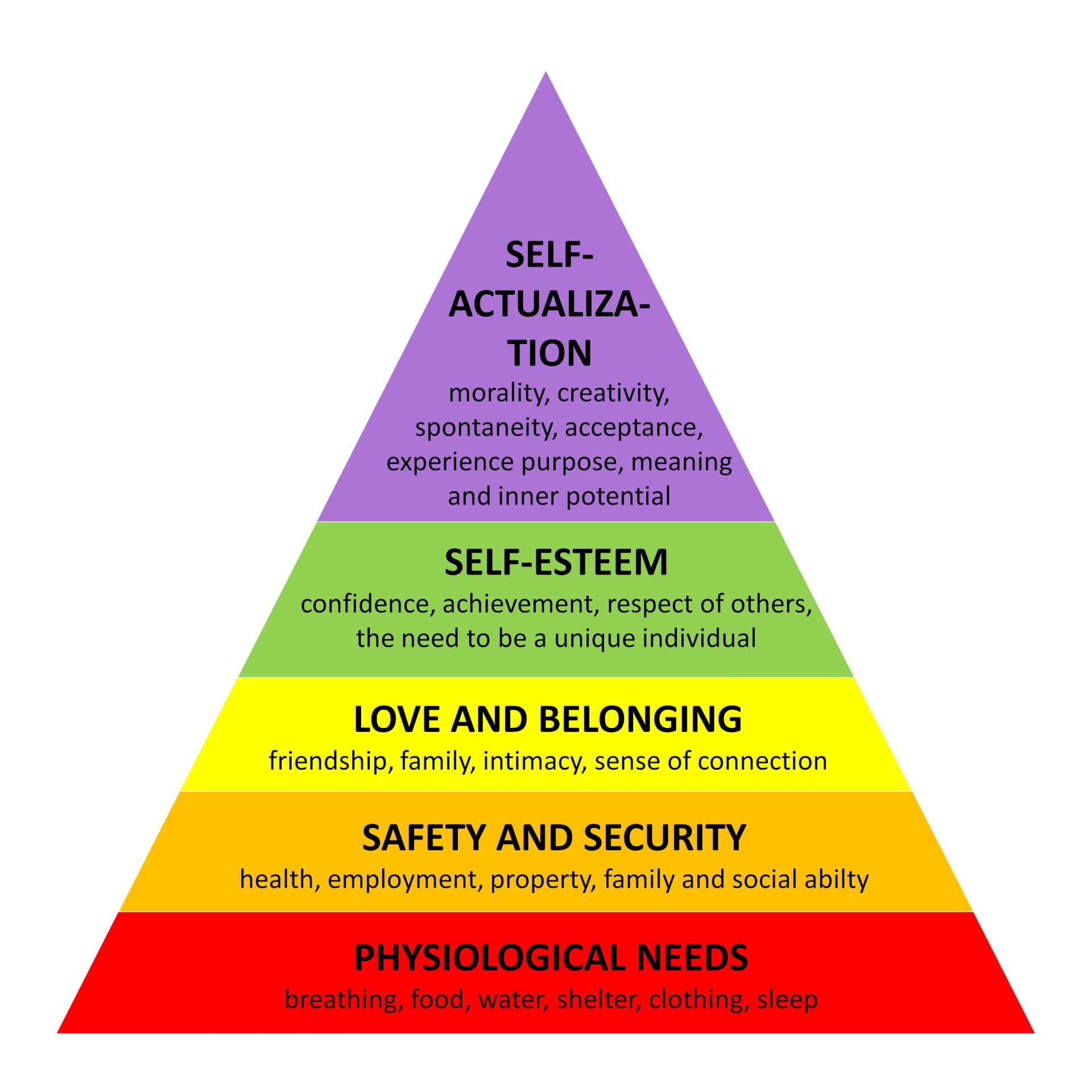
Maslow's theory of Hierarchy of Needs states that some needs take precedence over others. The below pyramid represents the different levels of the hierarchy of needs, where our basic needs are at the base, then our psychological needs, and then our self-fulfillment needs are at the top. This does not devalue self-fulfillment needs, but it highlights how our basic needs need to be met in order to create a base for the rest of our needs to be achieved. This is an important theory to consider as teachers because we can use it to pinpoint the root cause of our students' behaviours in class. If students are tired, disengaged, lethargic, or defiant, it is important to determine whether the needs of the following chart of being met. If a student's basic needs are not being met, then it will influence their behaviour and their ability to succeed in the classroom. 

In regards to drama, we need to consider all of the following needs of our students in the drama class. Drama often requires physical activity, thus their psychological needs are particularly essential for success in drama to make sure that students are not too weak or tired. Regarding safety needs, we need to make sure that we create a physically safe environment with no safety hazards and take all necessary safety precautions. Regarding psychological needs, the drama classroom needs to be a place that is emotionally safe, open, and welcoming so that students fell comfortable to participate openly. Lastly, we need to allow students the opportunities to be creative in the drama classroom in order to promote self-fulfillment as well as make sure that we encourage students, so that they do not get discouraged and be afraid of participating in drama or other areas.
Image result for maslow's hierarchy of needs
Saul McLeod (2017). Maslow's Hierarchy of Needs (Online Image).
 [Retrieved from https://www.simplypsychology.org/maslow.html]


Tuesday, 6 February 2018

Critical Positioning Theory

In class this week, we discussed Davies' and Harré's (1990) theory of critical positioning. This was my first time learning about this theory, which essentially states that there are different levels of identities and contexts that influence who we are and our critical perspectives. There are stable identities, such as our age, sex, nationalities, culture, and family and there are flexible identities such as our interests, jobs, relationships, and our style/fashion, which are all influenced by current contexts and vice versa. In discussing this theory in relation to drama, we discussed how drama is one of the only experiences we are able to escape our stable identities to consider the identities, experiences, and perspectives of others by taking on roles.

Natalie McMillan (2018). Critical Positioning Theory (Photograph) 


Tuesday, 30 January 2018

Multiple Intelligences

Gardner's (1983) theory of multiple intelligences states that people have a tendency and preference to learn in different ways and that everyone is intelligence in different ways. This is crucial for teachers to understand because it highlights the needs for differentiated learning and because it is essential that we recognize that all students can be intelligence, even if they struggle academically. The following image represents eight intelligences included in Garnder's theory, which are as follows: verbal/linguistic, logical/mathematical, naturalist, bodily/kinesthetic, musical/rhythmic, inter-personal/social, intra-personal/introspective, visual/spatial.
Image result for multiple intelligences
chudecka_dorota (n.d.). What is multiple intelligences (Online Image).
Retrieved from https://www.google.ca/search?q=multiple+intelligences&source=lnms&tbm=
isch&sa=X&ved=0ahUKEwiYoqiHwbrZAhUNiIMKHUzXAB4Q_AUICigB&biw
=1242&bih=569#imgrc=4YqBIoAZZt-HbM:
In class, we discussed the different subjects that relate closely with each other intelligences (pictured below). Within our discussions, we concluded that drama best relates to bodily/kinesthetic and verbal/linguistic, although it is also important to realize that a successfully differentiated class would involve each of the eight intelligences


Wednesday, 24 January 2018

Dwyer's Learning Theory

This week was our first session of drama and we discussed Dwyer's (1996)  Learning Theory. This theory highlights how, on average, students remember a different percentage of information when they engage with that information in different ways. It states that students remember 10% of what they hear, 20% of what they see, 30% of what they read, 50% of what they write, 70% of what they say/discuss, 80% of what they do, and 90% of what they teach. This theory highlights the importance of differentiating our teaching and learning experiences so that students have the opportunity to engage with information in different ways and it promotes the importance of rich learning experiences, where students have opportunities to discuss, actively participate, and teach, in order to activate a higher percentage of their memory.

Image result for students remember 90% of what they teach
The Learning Pyramic [Online Image]. Retrieved from
https://www.lifehack.org/399140/how-to-remember-90-of-everything-you-learn